
Dometic DM Refrigerator Not Cooling? Narrow Down the Problem Before Buying Parts
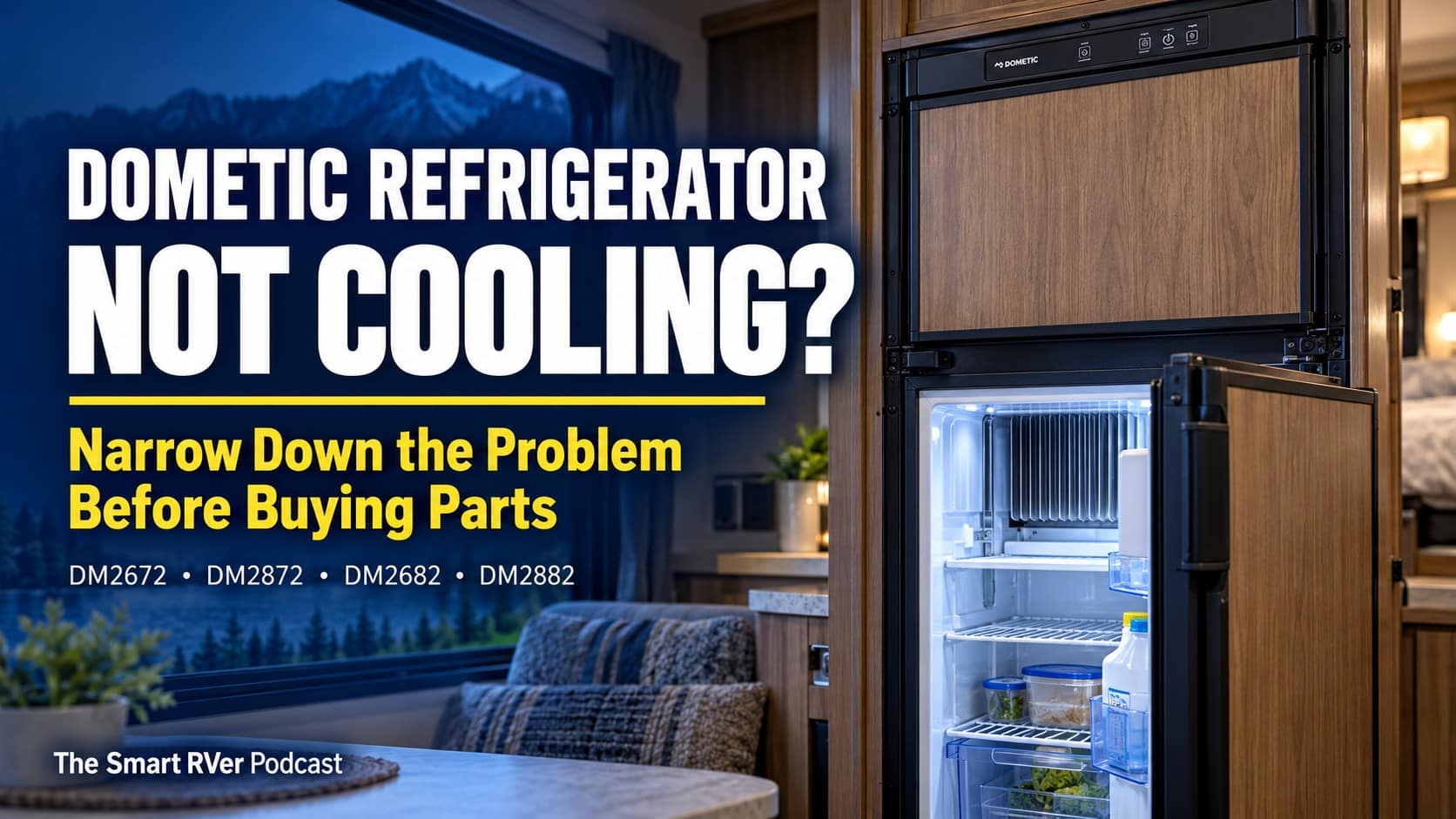
Listen to the episode and get the troubleshooting resources
[INSERT PODCAST PLAYER: Dometic DM Refrigerator Not Cooling? Narrow Down the Problem Before Buying Parts]
[INSERT YOUTUBE VIDEO, IF AVAILABLE]
Keep these resources handy while you read:
- Download the Dometic DM Refrigerator Troubleshooting Checklist – Record your model number, operating mode, temperatures, symptoms, and next step.
- Download the Owner’s Manual
- Download the Service Manual
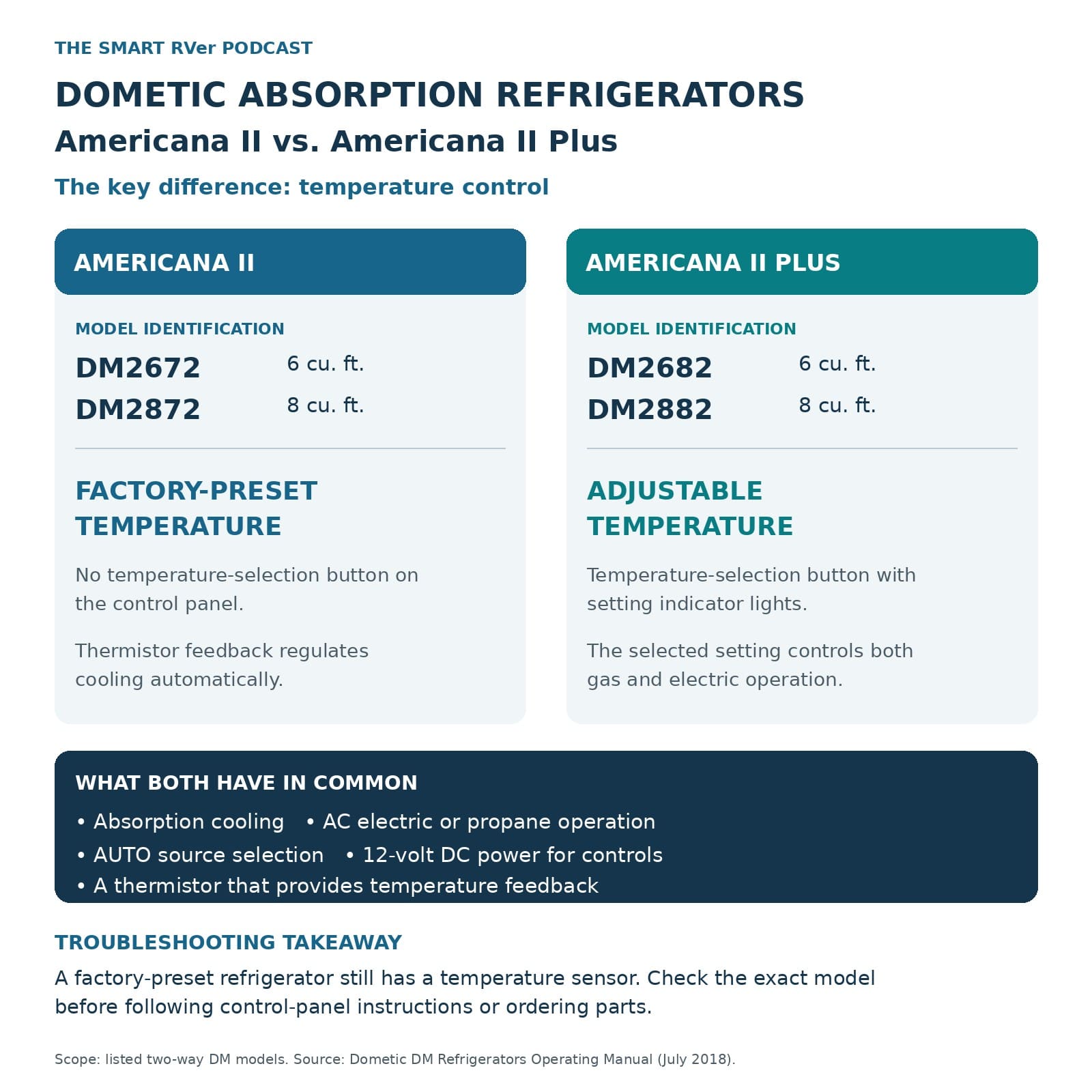
Americana II vs. Americana II Plus: identify your model first
The similar names can make these refrigerators easy to mix up. For this episode, the important distinction is the temperature control.
| Refrigerator family | Models covered here | Temperature control |
|---|---|---|
| Americana II | DM2672 and DM2872 | Factory preset |
| Americana II Plus | DM2682 and DM2882 | Adjustable from the control panel |
Check the model label before following a temperature-control or troubleshooting procedure.
Both groups use absorption cooling. An AC electric heater or a propane burner provides heat to drive the process. They also need 12-volt DC power for the electronic controls—even while connected to shore power.
In AUTO mode, the refrigerator can switch to propane when AC power is unavailable. Being plugged in doesn’t mean it is cooling on electric power. Dometic’s operating manual documents these basics and the temperature-control distinction.
Five questions to answer before buying refrigerator parts
Use the printable checklist to work through these questions:
- What is the exact model? Record the model and serial number, and photograph the data label.
- Does it have proper control power? Establish that the refrigerator receives the DC power its controls need.
- Which heat source is actually operating? Identify AC electric, propane, or an unconfirmed source.
- Does the problem affect one source or both? Separate a source-specific failure from a shared cooling problem.
- What evidence supports the part you plan to replace? Write down the observation or test result behind the decision.
“It is not cold” is the starting complaint. These answers give you a useful diagnostic direction.
Stop when you see signs of a hazardous failure. Propane odor, ammonia odor, suspected leaks, soot, or burned wiring require attention before further operation. For propane odor, avoid ignition sources and electrical switches, leave the area, and follow emergency guidance. Do not restart a refrigerator with suspected cooling-unit leakage on another heat source. Never bypass a safety device. Gas-system repairs and live AC testing belong with a qualified technician.
1. Dometic refrigerator will not turn on
Start by proving power reaches the refrigerator.
A compartment light alone does not establish that the control system has adequate power. Likewise, a battery reading taken elsewhere in the RV does not prove the same voltage reaches the refrigerator through its wiring and connections.
Begin with accessible checks:
- Confirm the battery disconnect is in its normal operating position.
- Check the identified refrigerator DC supply fuse.
- With power isolated, look for accessible loose, corroded, or damaged connections.
- Replace a blown fuse only with the specified type and rating. If it blows again, investigate the cause.
If you know how to use a meter safely, the model documentation can help identify an accessible DC supply point. Otherwise, have the supply checked by a technician.
A dead control panel is a symptom, not proof that the circuit board failed. Establish supply power before deciding what the controls need.
2. Refrigerator cools on propane but not electric
If it cools properly on propane under comparable conditions, focus the next investigation on the electric heating path. First, confirm that the propane result represents actual cooling over time. Hearing ignition does not establish good cooling performance. Check the RV’s AC supply and the identified refrigerator branch breaker. If the refrigerator’s plug and receptacle are safely accessible, check for an obvious disconnected plug. An upstream GFCI may also matter if your installation uses one. Avoid reaching into an energized equipment compartment.
With the right tests, a technician can distinguish between missing AC input, a failed heating element, damaged wiring, and a control-output problem. Do not order an element based only on the complaint. Its resistance specification and test procedure must match the installed heater, with power isolated for resistance testing.
Watch the AUTO-mode trap: propane fallback can hide an AC problem. Confirm the operating source using your model’s instructions instead of assuming that shore power means electric cooling.
3. Refrigerator cools on electric but not propane
This symptom points to the propane supply, ignition, burner operation, and flame sensing.
Record what happens when gas operation is selected:
- Is there no ignition sound?
- Does it attempt ignition without establishing a flame?
- Does a flame start and then go out?
- What does the CHECK indicator do?
The covered models’ manual associates the CHECK indication with unsuccessful burner ignition. It does not identify one particular failed component. Follow the applicable restart instructions; repeated resets are not a repair.
Confirm propane availability and normal valve positions according to the manual. Another propane appliance working is a useful clue, but it does not prove correct pressure or supply at the refrigerator.
Possible service areas include the burner and flue, ignition electrode, flame sensing, gas supply, wiring, valve, and controls. Your observations help determine the next test.
Leave gas-pressure testing and gas-system repairs to qualified service personnel. Never enlarge a burner orifice with a wire or drill.
4. Refrigerator runs but does not cool properly
An indicator light or operating burner indicates activity. Thermometer readings tell you what is happening inside the compartments.
Before suspecting the cooling unit, review the conditions:
- How long has the refrigerator been running?
- Was it recently loaded with warm groceries?
- Have the doors been opened frequently?
- Do the doors close properly?
- Is frost interfering with operation?
- Is food packed tightly around the cooling fins?
- Are visible outside ventilation openings obstructed?
- Does the complaint change with outdoor temperature or parking conditions?
Use thermometers in both compartments and record the trend. Keep test conditions as consistent as possible when comparing propane with electric operation.
Installation airflow, baffles, and fans where fitted may need professional evaluation. Compare the installation with the correct installation documentation before adding fans or changing vent arrangements.
If both heat sources perform poorly, look at the shared conditions before buying separate propane and electric parts. A freezer getting cold while the fresh-food compartment stays warm is useful information, but it doesn’t identify a single failed part.
Temperature sensor and thermistor: the same component
The thermistor provides temperature feedback to the controls. On these models, the probe mounts on the fresh-food compartment’s cooling fins. Check its mounting against your exact manual.
An unplugged or failed sensor can cause continuous cooling in the documented limp mode. That removes normal temperature feedback; it does not directly power the heater or bypass overheat protection.
Unplugging it is not a routine owner repair. Any controlled diagnostic test should follow the applicable service procedure. Improved cooling during such a test warrants investigation of the sensor, placement, wiring, and control circuit; it does not prove the thermistor alone is bad.
5. Refrigerator works intermittently
An intermittent problem needs a record, not a guess.
Before restarting the refrigerator, photograph the control panel and note the operating mode. Use the checklist to record:
- Date, time, and elapsed run time.
- Fresh-food and freezer temperatures.
- Actual heat source, if confirmed.
- Outdoor conditions and shore-power status.
- Indicator behavior and the exact symptom.
A pattern such as “fails only on propane” or “warms up every hot afternoon” is much more useful than “sometimes it works.” Bring that record when seeking service or ordering parts.
Listen to The Smart RVer Podcast for practical DIY RV maintenance and repair guidance. Take care of the little things, and enjoy the trip.


