
Norcold RV Refrigerator Not Cooling? Troubleshooting Before You Buy Parts
Your Norcold RV refrigerator is warm, the groceries are already packed, and you’re wondering whether to order a circuit board or start shopping for a replacement. Before spending that money, take a few minutes to organize the problem.
Start Norcold refrigerator troubleshooting by identifying the exact model, recording any fault indicators, and comparing propane and electric cooling. Then work through the basic operating conditions and power checks. These observations help you choose the next step instead of guessing and buying parts.
This guide accompanies episode 214 of The Smart RVer Podcast and focuses on Norcold absorption refrigerators, particularly the N6XX and N8XX families and Polar N7/N8 absorption models. It is an owner-level diagnostic starting point; component tests must follow the manual for your exact refrigerator.
Start With Five Questions
Before opening an access panel, write down your answers:
- Does the refrigerator turn on?
- Does it cool on 120-volt electric?
- Does it cool on propane?
- Are both compartments warm, or is the freezer getting cold while the refrigerator stays warm?
- Is there a fault code, flashing light, or alarm?
“It works on propane but not electric” is a useful clue. “It doesn’t work” leaves almost everything open. Photograph the control display before switching modes or turning the refrigerator off.
Keep a thermometer in each compartment and record temperatures alongside elapsed running time. A single reading tells you far less than a record showing what changed during a test.
Download the Norcold Troubleshooting Checklist
Identify Your Norcold Model First
Norcold’s N6/N8 support information covers both two-way and three-way absorption refrigerators. Polar N7/N8 absorption models also have different configurations. Read the full identification label, including suffixes, before choosing a manual or ordering parts.
Do not use the letter “N” alone to identify the cooling system. For example, the Polar N8DC is a 12-volt compressor refrigerator, which requires a different troubleshooting approach.
Record the refrigerator’s complete model and serial numbers. If service or recall identification requires a cooling-unit serial number, locate it separately.
Understand Propane, Electric, and AUTO Modes
An absorption refrigerator uses a heat source to drive its cooling process. Its electric and propane operating modes provide that heat in different ways.
| Operating mode | What supplies the heat? | What to remember |
|---|---|---|
| AC electric | A heating element powered by 120-volt AC | AC supply and DC control power both matter. |
| LP propane | A propane burner | Gas operation still requires DC control power. |
| DC electric, where fitted | A separate 12-volt heating element | Available only on appropriate three-way models. |
| AUTO | The controls select an available energy source | Selection behavior depends on the model. |
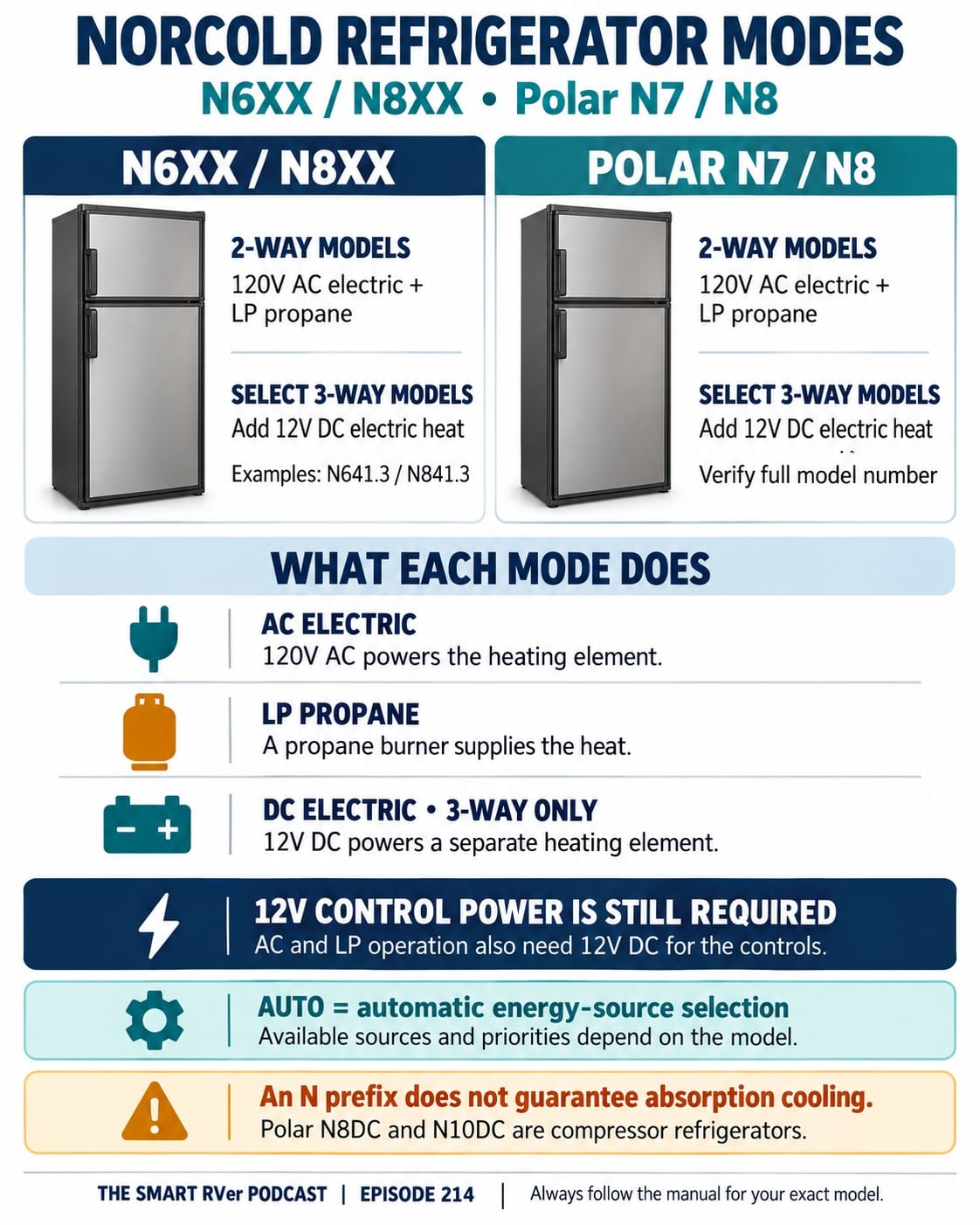
The N6/N8 installation documentation describes separate AC, DC, and propane connections and model-specific controls. Use the matching manual to confirm your configuration. [4]
Twelve-volt control power and twelve-volt cooling heat are different things. A two-way refrigerator may require DC power for its controls but not offer a DC heating mode.
Check the Conditions Before Testing Parts
Make sure the RV is level within the refrigerator manufacturer’s stated limits. Check door closure, food placement, and frost accumulation. Avoid covering shelves in a way that restricts airflow.
Give the refrigerator its specified startup time. For the Polar models covered by the linked owner’s manual, Norcold specifies eight hours of cooling before loading food. That manual also directs owners to contact service if cooling hasn’t started after about two hours. These are different milestones: beginning to cool and being ready to load. [2]
For a useful test, avoid repeatedly opening the doors or adding warm groceries. Write down the start time and outside conditions so you can make a meaningful comparison later.
Norcold Refrigerator Won’t Turn On: Check Control Power
A blank display points to the refrigerator’s DC supply before you buy a replacement board. Shore power at the campsite doesn’t confirm that power reaches the refrigerator’s control circuit.
Review the battery disconnect position, the appropriate RV fuse, and accessible connections. A qualified person can measure voltage at the refrigerator and check its ground connection against the model’s specifications. Use the required fuse type and rating; never substitute a larger fuse. [4]
Record what was checked and the results. “The lights work in the RV” is different evidence from a voltage measurement at the appliance.
Works on Propane but Not Electric?
That comparison gives you a reasonable diagnostic direction: investigate the AC supply and electric-heating path before assuming the entire cooling system has failed.
Start with accessible owner checks in the manual, including the relevant breaker and whether an upstream GFCI has tripped on the refrigerator outlet. If a protective device trips again, investigate the cause rather than repeatedly resetting it.
The N6/N8 installation manual requires a grounded AC connection and a separate DC supply. Verifying one does not verify the other. Only someone equipped and qualified should perform internal heater or board testing. [4]
Works on Electric but Not Propane?
Use that result to focus the next investigation on propane operation. Confirm fuel availability and the owner’s manual valve/startup instructions, then record what happens during the ignition attempt.
Does it attempt ignition? Does it report a fault? Does it run initially and then stop? Those observations help you choose the next test without treating the clicking sound as a complete diagnosis.
For Polar models, the manual separates burner-ignition faults from other control conditions. Use that guidance rather than a code chart for another refrigerator. Gas-pressure measurement, burner service, and adjustments require the proper tools and service procedure. [2]
Runs but Doesn’t Cool Well on Either Mode?
When both heat sources produce poor results, broaden the investigation to conditions affecting overall performance. Exterior ventilation deserves particular attention.
The Polar installation manual specifies vent locations, enclosure clearances, and baffles so heat can escape through the intended path. A sidewall upper vent has different installation requirements than a roof-vent arrangement. Where fans are part of the installation, their function also matters. [5]
Inspect for accessible obstructions without touching hot components. Do not remove baffles or modify the installation based on a generic online suggestion. Compare it with the exact installation manual.
A freezer that gets cold while the food compartment remains warm is a symptom to record, not a parts diagnosis by itself. Give the technician the temperatures, running time, operating mode, and recent history.
Fault Codes Are Clues, Not Shopping Lists
A fault identifies a condition the controls detected. It does not necessarily establish which component needs replacement.
Polar V, X, and LX versions present faults differently. Certain thermistor faults can also trigger backup temperature control, so continued operation does not prove normal regulation. Follow the correct owner’s manual for the displayed indication and any permitted reset. [2]
Do not keep clearing a recurring fault to make it disappear. Document it and resolve the cause.
Stop for Safety Problems and Check Recall Eligibility
If you smell propane or ammonia, stop troubleshooting. Avoid flames and electrical switches, leave the RV, and contact emergency assistance from a safe location. Follow the manufacturer’s emergency instructions; do not continue a cooling test. Never bypass protective devices or attempt to recharge an absorption cooling unit. [2][5]
Check Norcold’s official recall information using the required identification numbers. Its N6/N8 cooling-unit recall lists certain N621, N641, N821, and N841 units within a specified cooling-unit serial range. A model number alone does not determine eligibility. [6]
What to Gather Before Ordering Parts or Calling for Service
Put these details in one place:
- Full refrigerator model and serial numbers.
- Photos of labels and fault indications.
- Results on propane and electric, with running times.
- Refrigerator and freezer temperatures.
- Relevant power readings taken by a qualified person.
- Recent changes, intermittent behavior, and work already performed.
This record gives the next person a useful starting point and helps keep the conversation focused on evidence.
Listen to Episode 214 and Use the Checklist
Listen to “Norcold RV Refrigerator Not Cooling? Troubleshooting Before You Buy Parts” for a practical discussion of organizing your diagnosis.
Download the Norcold Refrigerator Troubleshooting Checklist to record symptoms and test results. Keep it with your RV maintenance records, and bring it along if the refrigerator needs professional service.
Have a Dometic absorption refrigerator? See episode 213 and the companion Dometic DM refrigerator troubleshooting article.
The goal is straightforward: identify the refrigerator, understand the symptom, and check the basics before spending money. Take care of the little things, and enjoy the trip.
Manufacturer Resources
[1] Norcold N6/N8 series support and manuals
[2] Polar N7/N8 owner’s manual: V, X and LX variants
[3] Polar N8DC compressor refrigerator support
[5] Polar N7/N8 installation manual
[6] Official Norcold recall information
Choose documents by complete model number and revision. These manuals do not cover every Norcold refrigerator.


