
Crowd-Free Winter RV Boondocking
 If you’ve ever stood in a popular national park parking lot on a Saturday in March, you know the soundtrack: generators humming, doors slamming, kids yelling, engines idling. The scenery may be amazing, but the vibe isn’t exactly peaceful.
Now picture the complete opposite.
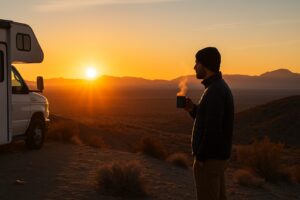
You wake up in your RV on a chilly January morning. The desert is absolutely still. You step outside with a steaming mug of coffee and the silence is so deep you can literally hear your coffee steam. No crowds, no traffic, just distant coyotes and the soft crunch of gravel under your boots.
That’s the idea behind Winter RV Boondocking—strategically-timed winter trips to some of the Southwest’s most beautiful desert landscapes, when the crowds are gone but the magic is very much alive.
For this “Next Stop” adventure, we’re focusing on three standouts:
- Anza-Borrego Desert State Park, CA
- Mojave National Preserve, CA
- Organ Pipe Cactus region, AZ
Each offers big skies, wide-open camping, and room to breathe—especially on January weekdays.
Why January Weekdays Are “Super-Quiet”
The desert has its own rhythm, and if you match your travel dates to it, you’re rewarded with solitude.
- Holidays are over. The New Year rush has faded, kids are back in school, and most people have burned through their vacation days.
- It’s too “cold” for casual visitors. Daytime temps can be perfect for hiking, but chilly mornings and nights scare off the flip-flop crowd.
- Midweek is magic. Monday through Thursday typically has fewer day-trippers, tour buses, and weekend warriors.
The result? Trailheads with open parking, slot canyons without conga lines, and camp areas where you might see more stars than neighbors.
The Desert Super-Quiet RV Winter Boondocking Triangle
1. Anza-Borrego Desert State Park, California
Vibe: Slot canyons, badlands, palm oases, and a sky so huge it feels like a planetarium.
 Anza-Borrego is famous for spring wildflowers, but in January it becomes a quiet playground for RVers who like space. Dispersed camping on surrounding BLM land and select park areas (where allowed) means you can find boondock spots with 360-degree views of desert mountains.
Why it shines during Super-Quiet Weeks:
- Popular slot canyons and washes are far less crowded.
- Cooler temps make mid-morning and afternoon hikes comfortable.
- Small desert towns nearby are calmer, making it easier to fuel up and restock.
2. Mojave National Preserve, California
Vibe: A dreamscape of Joshua trees, lava flows, sand dunes, and railroad history.
Mojave can feel incredibly remote even in peak season. In January, on a weekday, it can feel like you’ve got your own private desert empire. You’ll find both developed campgrounds and wide-open boondocking areas (within regulations), plus long, quiet drives between historic outposts.
Why it fits the Super-Quiet theme:
- Long sight lines and very light traffic—ideal for slow, scenic drives.
- Chilly nights encourage campfire time and early-morning stargazing.
- You can often explore dunes or backroads with minimal company.
3. Organ Pipe Cactus Region, Arizona
Vibe: A living cactus museum with some of the most dramatic desert scenery in the Southwest.
The Organ Pipe area brings towering cacti, rugged mountains, and spectacular sunrises. Established campgrounds plus nearby boondocking options (where legal) make it a great base for scenic drives and day hikes.
Why January weekdays are prime:
- Daytime temps are comfortable for longer hikes and scenic drives.
- Sunrise and sunset light on the cacti is incredible—and you’re not elbowing for tripod space.
- Quieter campgrounds mean more wildlife and less generator noise.
Layering & Hiking Windows: Working with the Desert’s Daily Rhythm
Deserts in January are cold in the morning, perfect in late morning, and can still be cool at night. Plan your days around that rhythm:
Smart Layering
 Pack a simple layering system:
- Base layer: Moisture-wicking thermal top and leggings for cold mornings.
- Middle layer: Fleece or light insulated jacket.
- Outer layer: Windproof shell or light puffy for breezy ridges and night sky sessions.
- Accessories: Beanie, gloves, and a buff or neck gaiter.
Mornings start with all the layers; by late morning, you’re peeling down to a t-shirt. Evenings, the layers go back on as temps drop quickly after sunset.
Morning Hiking Windows
For Desert Super-Quiet Weeks, your ideal hiking window is often:
- Start: Shortly after sunrise once the chill eases.
- End: Early to mid-afternoon, before the day’s driest wind and coolest shadows.
Plan your bigger adventures—slot canyon hikes, longer loops, or ridge walks—inside that window. Use late afternoon for short strolls, scenic drives, or campfire prep.
Simple Winter RV Boondocking Etiquette for Ultra-Quiet Desert Trips
 “Super-quiet” isn’t just about timing; it’s also about how we behave once we’re there. A few simple rules keep the desert peaceful for everyone.
- Give space. If you’re boondocking, don’t tuck in right next to someone when there are acres of open land. Spread out so each rig has its own “view bubble.”
- Mind the generator.
- Use batteries and solar as much as possible.
- If you run a generator, keep it to short, predictable windows—often morning coffee time and early evening, not late at night.
- Use batteries and solar as much as possible.
- Dark sky friendly lighting. Turn off bright exterior lights when you go inside. The stars are the show.
- Respect quiet hours—even if they aren’t posted. Treat 9 p.m.–7 a.m. as quiet time: no loud music, no revving engines, no prolonged mechanical work.
- Leave no trace. Pack out all trash, use proper waste disposal, and don’t create new tracks or campsites where they’re not allowed.
Super-quiet weeks work when everyone shares the same unwritten goal: silence, space, and a sense of refuge.
Planning Your Own Desert Super-Quiet Week
A simple planning checklist:
- Pick your window: Aim for a January weekday stretch—Sunday night through Thursday night is perfect.
- Choose your anchor destination: Start with one of the three locations (Anza-Borrego, Mojave, Organ Pipe) and optionally connect two in a loop if you have more time.
- Check access & road conditions: Desert storms can wash out dirt roads; verify conditions before heading deep into the backcountry.
- Stock up ahead of time: Fuel, water, groceries, and propane—treat each desert zone like a “last outpost” before you head in.
- Have a backup plan: Identify a second camping area in case your first choice is full or closed.
Do that, and you’re ready to experience what RVers mean when they say, “The silence was so still I could hear my coffee steam.” Winter RV Boondocking!


