
Topargee RV Water Gauges: A Better Way to Track Your Fresh Water
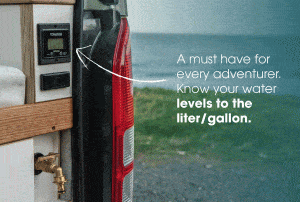 Most RVers have pushed the fresh water button on their monitor panel and wondered whether the reading is even close.
The panel may say full, two-thirds, one-third, or empty, but that does not tell you how many gallons are actually available. When you are camping with full hookups, that may not matter very much. When you are dry camping or boondocking, it can make a big difference.
Do you have enough water for another day? Can everyone take a shower? Should you refill now, or can it wait until tomorrow?
Topargee RV water gauges offer a different way to answer those questions. Rather than trying to sense the water level through the side of the tank, they measure the water flowing through the fresh water line and calculate how much should remain.
Let’s look at how that works, what its limitations are, and how the three available Topargee gauges differ.
Why Factory RV Water Gauges Can Be Frustrating
Most factory RV monitor panels provide only a general tank reading:
Full
Two-thirds
One-third
Empty

RV fresh water tanks also come in many shapes. Some are long and shallow, while others are deeper or irregularly shaped. The location of the sensors and the position of the RV can affect how useful the reading is.
A factory monitor is generally best viewed as an estimate. It can give you an idea of the tank level, but it usually cannot tell you how many gallons you have left.
For RVers who regularly camp without water hookups, that lack of information can make water planning difficult.
How a Topargee RV Water Gauge Works
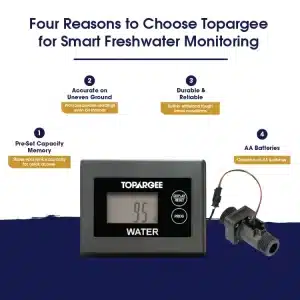 A Topargee RV water gauge does not measure the physical water level inside the tank. It uses an inline sender installed in the RV’s fresh water plumbing.
As water passes through the sender, the gauge measures the amount being used. You program the gauge with the starting capacity of your tank, and it counts down as water flows through the system.
For example, imagine that your RV has a 40-gallon fresh water tank.
You fill the tank and set the gauge for 40 gallons. After the gauge measures 10 gallons flowing through the water line, it displays approximately 30 gallons remaining.
This is the main difference between the two systems:
A factory monitor estimates the level inside the tank.
A Topargee RV water gauge calculates the water remaining by measuring usage.
No probes or sensors need to be installed inside the tank. The Topargee sender connects to the water line instead.
What a Topargee RV Water Gauge Can Tell You
Once the gauge is installed and programmed, it can help you answer practical questions such as:
How much fresh water is left?
How much water did that shower use?
How many gallons are we using each day?
Can we camp another night before refilling?
Do we need to start conserving water?
This can be especially helpful when boondocking, staying in national forest campgrounds, visiting state and national parks, or camping anywhere without a convenient water connection.
It can also help you learn your normal water-use habits. Once you know how many gallons your household uses each day, planning a longer trip becomes much easier.
Important Limitations to Understand
A flow-based gauge is useful, but it is not magic. It must be installed, programmed, and reset correctly.
The gauge does not directly see the water inside the tank
It calculates the remaining amount based on the starting capacity and the water that passes through the sender.
You must update or reset it after adding water
If you completely refill the tank, reset the gauge to the programmed full capacity.
If you add only a specific amount, you will need to update the displayed capacity accordingly. The gauge cannot automatically detect water entering the tank through a separate fill line.
Water must pass through the sender to be counted
The installation location matters. The sender needs to be positioned where the water you want to measure flows through it.
Accuracy depends on correct setup
The tank capacity must be entered correctly, the sender must face the proper direction, and the plumbing installation must follow the manufacturer’s instructions.
Understanding these points prevents unrealistic expectations and helps the gauge provide useful information.
Comparing the Three Topargee RV Water Gauges
Topargee offers three primary gauge styles. They use the same basic flow-measuring concept, but they differ in how the information is displayed, how the display is mounted, and how it is powered.
Topargee H2F-BT12 Bluetooth Water Tank Gauge

There is no separate display screen to mount inside the RV. Your mobile device becomes the display.
Key characteristics
Displays water information through a mobile app
Works without an internet connection
Displays gallons or liters
Can be powered by AA batteries
A proper Topargee adapter is required when using 12-volt power
No large display opening needs to be cut
Works within normal Bluetooth range
Best suited for
The Bluetooth model makes sense for an RVer who is comfortable using a smartphone and wants to avoid adding another display to the RV’s interior.
It can also be helpful when the ideal sender location is not close to a convenient place for a physical display.
Things to consider
You need a compatible phone or tablet, and you will need to open the app when you want to view the reading.
The Bluetooth model should never be connected directly to the RV’s 12-volt system without the correct adapter. Its standard battery supply operates at a much lower voltage, so a purpose-built adapter is necessary to prevent damage.
Topargee H2F-FM Flush Mount Water Tank Gauge
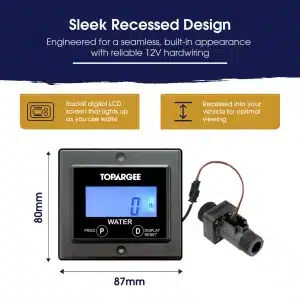 The H2F-FM is designed for a clean, built-in installation. Its display recesses into a cabinet face, dashboard, control panel, or wall.
It has a larger backlit screen and operates from 12-volt power.
Key characteristics
Large backlit LCD display
Recessed, flush-mount installation
Displays gallons or liters
Hardwired to 12-volt power
Provides live readings as water is used
Creates a clean, factory-style appearance
Best suited for
The flush-mount model is a good choice for a new installation, major renovation, van conversion, or an RV owner who wants the finished gauge to look like original equipment.
It is also useful when you want a permanently visible display without using a phone.
Things to consider
A flush-mount installation requires a properly sized opening and enough clearance behind the mounting surface.
Before cutting, check carefully for wiring, plumbing, structural framing, and other hidden components.
Because the display is polarized, its mounting height and viewing angle should also be considered before making the opening.
Topargee H2F-SM Surface Mount Water Tank Gauge
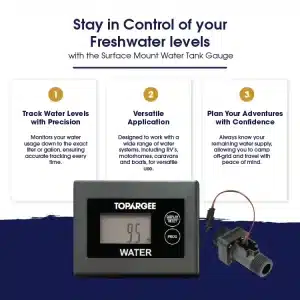 The H2F-SM provides a physical LCD display without requiring a large recessed opening.
It can be mounted in its cradle with screws or suitable double-sided tape. It is powered by AA batteries, so a separate 12-volt connection is not required.
Key characteristics
Compact LCD display
Surface-mount installation
Displays gallons or liters
Powered by AA batteries
No external power connection required
Can be mounted with screws or double-sided tape
Stores the programmed capacity in memory
Best suited for
The surface-mount model is well suited to aftermarket and DIY installations.
It is a practical choice when you want a dedicated display but do not want to cut a flush-mount opening or run a new 12-volt power circuit.
Things to consider
The display sits on the mounting surface rather than being recessed into it. That makes installation easier, although it will not have the same built-in appearance as the flush-mount model.
Which Topargee Gauge Is Right for Your RV?
Here is the easiest way to compare them:
| Model | Display | Power | Mounting | Best For |
|---|---|---|---|---|
| H2F-BT12 | Smartphone or tablet | AA batteries or approved 12V adapter | Bluetooth module on bracket | RVers who prefer an app and no wall display |
| H2F-FM | Large backlit LCD | Hardwired 12V | Recessed flush mount | Clean, permanent, factory-style installations |
| H2F-SM | Compact LCD | AA batteries | Surface-mounted cradle | Easier DIY and aftermarket installations |
Choose the H2F-BT12 Bluetooth model when you prefer using your phone and do not want to mount a separate screen.
Choose the H2F-FM flush-mount model when appearance and a permanently visible display are the priorities.
Choose the H2F-SM surface-mount model when you want a physical display with the simplest mounting and power requirements.
Topargee Installation Considerations
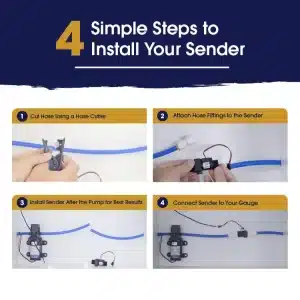 The basic concept is straightforward, but it is worth planning the installation before cutting any water line.
Select the sender location carefully
Topargee generally recommends installing the sender on the pressure side of the water pump. A short section of straight plumbing after the pump or other fittings helps stabilize the water before it reaches the sender.
The sender can sometimes be installed before the pump when necessary, but connections on the suction side must be completely airtight. A small air leak may not drip water, yet it can still allow air into the plumbing and cause water to drain back toward the tank.
Special Fittings Are Required For U.S. Installations
Follow the direction-of-flow arrow
The sender measures flow in one direction. Install it so the arrow points in the normal direction of water flow.
If it is installed backward, the system will not record normal water use correctly.
Use compatible plumbing fittings
Topargee senders use BSP-style connections. Many North American RVs use NPT threads, PEX tubing, flexible reinforced hose, or a combination of plumbing systems.
That means adapters may be necessary.
Do not force mismatched thread types together. Use fittings intended to adapt the sender to the RV’s plumbing system.
Keep debris out of the sender
Small pieces of thread-seal tape, plastic shavings, and other debris can interfere with the sender’s internal impeller.
Keep the plumbing clean during installation and avoid allowing excess sealant to extend into the water passage.
Do not cut or splice the sender cable
When more cable length is required, use the proper extension lead.
Cutting or joining the sender wire can interfere with communication and may void the warranty.
Test carefully for leaks
After installation:
Fill or partially fill the fresh water tank.
Turn on the water pump.
Allow the system to pressurize.
Run water through several fixtures.
Inspect every new connection.
Wipe each joint with a dry paper towel.
A paper towel can reveal a very small amount of moisture that may be difficult to see by eye.
Check the fittings again after the RV has been used and driven.
Who Benefits Most From a Topargee Water Gauge?
A Topargee gauge may be especially useful for:
Boondockers
Dry campers
RVers with small fresh water tanks
Families trying to manage daily water use
Campers who stay in remote locations
Van and expedition-vehicle owners
RVers who do not trust their factory monitor
Anyone who wants to estimate how many camping days remain
It may be less important for an RVer who stays almost exclusively at full-hookup campgrounds and rarely uses the onboard fresh water tank.
That does not make the product good or bad. It simply means the value depends on how you use your RV.
Final Thoughts
A traditional RV monitor panel gives you a general idea of the water level. A Topargee RV Water Gauge takes a different approach by tracking the water that flows through the plumbing.
That can provide much more useful information for RVers who camp without hookups and need to manage a limited fresh water supply.
The Bluetooth, flush-mount, and surface-mount versions all perform the same basic job. The main decision is how you want to view the information and how involved you want the installation to be.
A Topargee RV Water gauge is not essential for every RV. But for dry campers, boondockers, and anyone tired of wondering what “one-third” really means, it can make fresh water planning far easier.
Better information does not create more water, but it can help you make every gallon last longer. Topargeee RV Water Gauges
Purchase Options on Sunpro Mfg


