

Money Saving Tips: 7 Oddball Ways RVers Cut Costs
Why “oddball” tips punch above their weight
Big upgrades (solar arrays, lithium banks) get the headlines, but small, repeatable behaviors often deliver the best cost-per-effort. These bonus oddball savers are field tricks RVers share at rallies and between campsites—easy to test, cheap to try, and simple to keep or ditch. And if one doesn’t fit your current rig or travel style, don’t toss it. Ideas are brainstorming fuel: add the tip to your notes or maintenance journal and pull it out later. Nothing goes to waste.
The 7 Bonus Oddball Savers (use 2–3 to start, then add more)
1) Water Heater “Batch Mode”
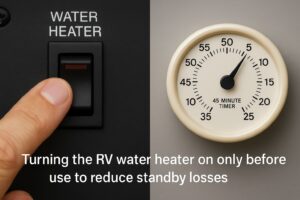 What to do: Run electric or LP water heat only 30–45 minutes before showers and dishes, then turn it off.
Why it works: You eliminate hours of standby losses where a tank constantly reheats water you aren’t using.
Bonus wins: Lowered energy or LP usage, quieter evenings, and often longer anode/element life because the heater cycles less.
Typical savings: ~$5–$20/month on hookups or LP, multiplied across a season—real money.
How to implement
- Add a timer (mechanical or smart switch) or a sticky-note reminder on the control panel.
- For families, stage “hot-water windows” (e.g., 6–7 a.m. and 7–8 p.m.).
- Keep a small kettle on the stove for quick dish-rinse top-ups if needed.
2) Standardize Filters Across the Rig
What to do: Convert to common 10” canisters and use the same cartridge type for park water, drinking line, and (if applicable) ice-maker.
Why it works: Buying one cartridge in bulk is 30–50% cheaper than chasing multiple proprietary sizes at retail, and it simplifies spares.
Setup ideas
- Stage: sediment → carbon (block).
- Label the canisters by flow order and change interval.
- Keep a dated sharpie note on each filter; rotate on a mileage or calendar schedule.
3) Propane Co-Op With Camp Neighbors
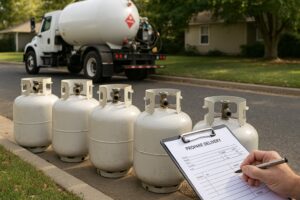 What to do: Coordinate a single mobile fill or caravan to a bulk supplier for 3–6 rigs.
Why it works: Sellers often discount volume or charge just one service call, shaving $0.10–$0.30/gal and saving time.
How to run it
- Post a signup sheet at the bulletin board or park app/chat.
- Confirm tank types (ASME vs DOT cylinders), valve rules, and payment method ahead of time.
- Group text when the truck’s en route; stage tanks at the curb to streamline.
4) “Two-Battery Policy” for Handhelds
What to do: Standardize headlamps, walkie-talkies, meters, and detectors on AA or AAA cells and carry a shared smart charger.
Why it works: You avoid emergency convenience-store prices and dead-gear disasters on travel days.
Typical savings: $30–$100/year, plus fewer last-minute runs.
Pro tips
- Keep one labeled “fresh set” and one “in use.”
- Store cells in a fire-resistant pouch; log a quarterly “battery health” check.
5) Gray-Water Pre-Filter at the Sink
What to do: Drop a mesh basket in the drain and line it with a coffee filter for meals with heavy scraps.
Why it works: Food bits foul sensors and contribute to odors and clogs. A pre-filter keeps the tank cleaner, cutting tank treatments and deep-clean intervals.
Savings: ~$20–$60/year (chemicals + water), and less stink.
Disposal: Tie off the used coffee filter and trash it; rinse the mesh basket after dishes.
6) Targeted Solar Shade Instead of Full-Day A/C
 What to do: Clip exterior shade over the sun-side windows and add a reflective windshield panel when parked.
Why it works: You’ll drop interior temps by a few degrees and can trim 0.5–1.0 kWh/hour of A/C runtime on hookups—or keep batteries happier off-grid.
How to place
- Walk the rig at noon and note hot glass; shade those panes first.
- Use removable clips, suction cups, or magnetic frames (where safe for glass and seals).
- We Recommend Sunpro Mfg Window Covers and Shade for your RV Sun Shade Projects.
7) “Parts Pairing” Before You Replace
What to do: When a converter, water pump, or propane regulator fails, upgrade to the model that supports your future plans (e.g., lithium-ready converter, variable-speed pump, two-stage regulator).
Why it works: You avoid buying twice when you inevitably add lithium, soft-starts, or more fixtures.
Typical avoided spend: $100–$400 (sometimes more) by skipping an interim replacement.
Putting it together without overwhelm
- Pick 2–3 bonus oddball savers for your next leg.
- Schedule them: timer for water heater, filter change day, propane co-op Friday.
- Measure something small—kWh, gallons, or dollars—to prove it’s working.
- Journal wins so you can repeat them. What doesn’t fit now? Save it—future you will thank you.
Conclusion: Make “bonus oddball savers” your everyday habit
These seven bonus oddball savers are small levers that add up: less propane burned, fewer emergency purchases, longer component life, and cooler cabins without cranking the A/C. Test two or three now, keep what works, and bank the rest for a future trip—because in RV life, the tip that doesn’t fit today might be the Hero tomorrow.


